
how yoga improves interoception
In this episode, we explore how yoga improves interoception - your nervous system’s ability to sense, interpret and respond to signals from inside your body - and how this awareness could help you build more helpful habits, plus:
How yoga gives us opportunities to practise notice, interpret, respond
What research on mindfulness and body awareness could tell us about interoception
Why noticing a sensation without jumping into judging it can - in time- potentially lead to a different response or outcome
How ahimsa, the yogic principle of non-harm, can inform the way we respond to discomfort other than defaulting to coping mechanisms (I see you doom scrolling, online shopping, and more 👀)
listen next
Understanding interoception and yoga — our introductory episode exploring what interoception is and why it matters, listen here
all of yoga podcast - episode 69
FREE MEDITATION
Body scan for noticing sensation - an interoceptive practice

This gentle body scan is an invitation to notice what you can feel, without needing to explain it, change it or decide whether it is good or bad.
You'll be guided slowly through the body, exploring sensations such as warmth, heaviness, tingling, tightness, softness, pulsing, spaciousness and stillness. The practice encourages you to stay with direct physical sensation, rather than getting pulled into the stories, worries or judgements that can so easily accompany what we feel in the body.
Over time, this kind of practice can help train your attention to stay in the present moment and become more comfortable simply noticing what is here.
You can practise lying down, sitting, standing or even gently moving, as long as you feel safe and comfortable.
There is nothing to achieve and no particular sensation you are supposed to find. Simply notice what you notice today.
listen to
how yoga improves interoception
where you get your podcasts
FREE JOURNAL PROMPTS
your free interception journal prompts
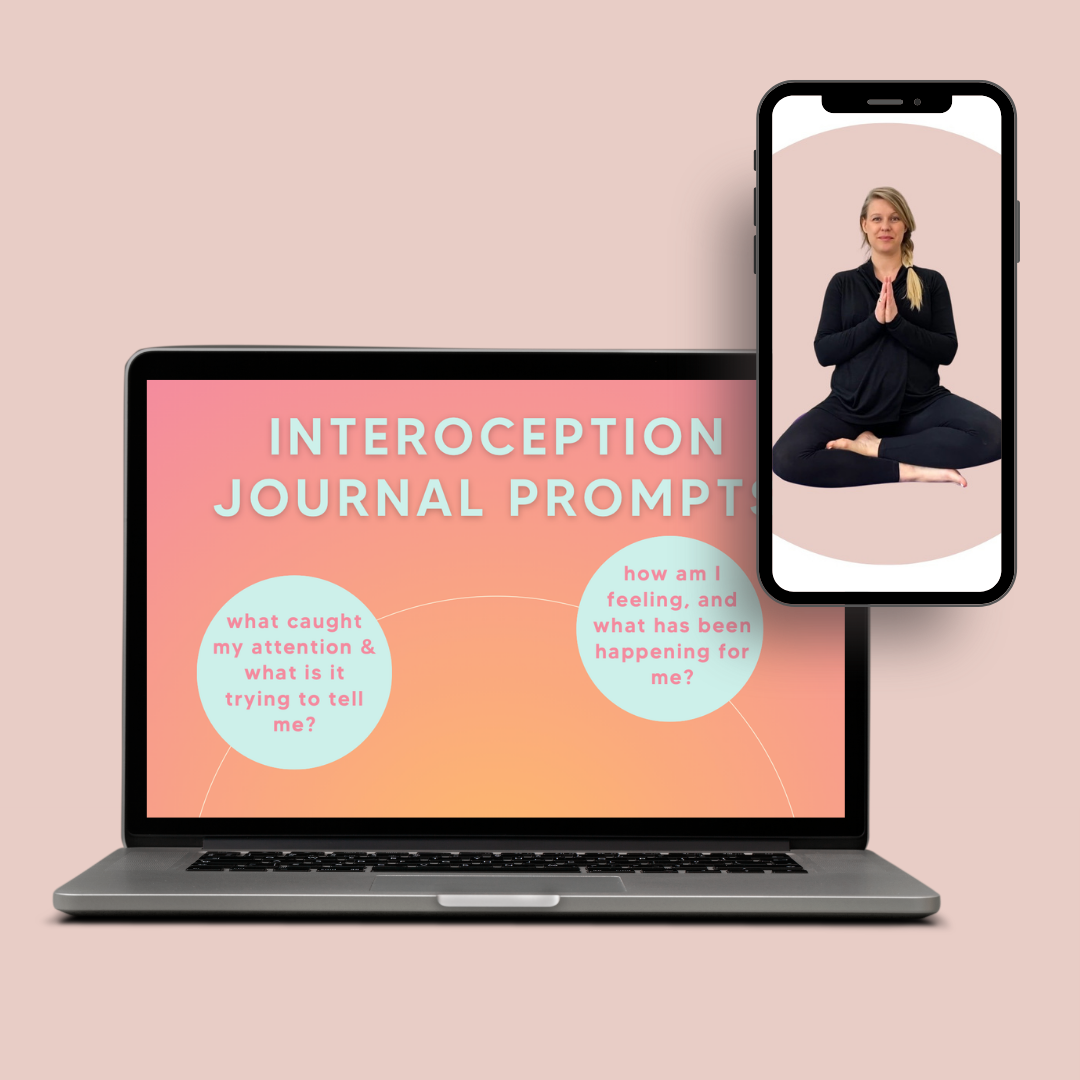
Interoception is our sense of what’s happening inside our body. It helps us notice signals such as hunger. Those signals can also contribute to our experience of emotions.
Your body offer you clues and signals and sensations, but it won’t tell you exactly why you feel that way.
Distraction (including doom-scrolling!), can sometimes offer short-term relief, and there’s no need to judge yourself for doing it. But when it takes you away from what matters to you, noticing earlier, might just open up another choice. That’s the invitation in these gorgeous journal prompts - to notice, pause, respond…
Transcript - How yoga improves interoception
How yoga improves interoception. so before we look at how yoga improves interoception, shall we take a moment to remind ourselves what [00:01:00] interoception is? Okay. Well, interoception is your nervous system sensing, interpreting, and responding to signals coming from inside your body. And if you need more of a refresher, you can find a link to the episode Understanding Interoception and Yoga, which is a deep dive here. That link is in the show notes
Okay, so back to how yoga improves interoception.
I'll take you through some mechanisms by which it is thought, pretty sensibly in my opinion, that yoga can help us connect with how we are inside, and then I'll break down why this has such a potentially positive impact on our physical and mental health. For a sneak peek here, I believe, and I'm not the only one, that building our interoceptive ability is the gateway [00:02:00] to building helpful habits.
Now, if you suspect your unhelpful habits are sliding into addiction or you're in recovery, you are so welcome to listen to this episode, but you'll probably already know that building your interoception is just one part, one healing strategy to undertake with many others, and this episode is not intended to be a one-size-fits-all approach to stopping all unhelpful behaviors.
if you'd like to talk through this further with your unique needs at the center of that conversation, please do get in touch. But if you're looking to stop biting your nails or drinking too much coffee, or you'd like to develop a morning meditation habit, for example, I think you'll find this episode really useful.
Okay. So let's go [00:03:00] How yoga improves interoception. Yoga is, in and of itself, the study of the self. The study, the observation, the presence of mind to sense how your hamstrings feel in this forward fold, that is interoception. So being present, feeling your hamstrings, and then making the decision of whether to back off a little or whether you have more space available and you can deepen the pose, this is deepening or building that sense of interoception, sensing how you are inside.
So taking the time to do this in your yoga class or in your yoga practice then facilitates the ability to sense that you're feeling a little bit hotter than you were a minute ago . your jaw is [00:04:00] tight or your shoulders are tight, and this interoceptive awareness might help us take a step back, a deep breath, a moment before speaking or reacting or reaching for our online shopping app or a glass of wine or a cigarette or whatever.
I want to be super clear here. There is absolutely no judgment around these behaviours. Some regulating behaviours, some coping mechanisms are more socially acceptable than others, but that does not necessarily mean that they are right or wrong or better or worse. I think the only person that can decide what's best for you is you.
Now, obviously, if your coping mechanisms hurt others, then that is not ideal. Okay, but that aside, your coping mechanism, your behaviour, your habit, it's there for a reason. [00:05:00] It's trying to protect you or it's better than the alternative or whatever. But if there is a behaviour that ideally would be better for you, like you'd prefer to have a herbal tea than a glass of wine every now and again, or you'd prefer to take a deep breath over losing your rag , then I think knowing all of this can really help All right, so now we've got that out in the open, let's get back to how yoga improves interoception. Well, some research by Holzel, I'm sure I'm absolutely butchering the pronunciation there, uh, in 2008 actually found that mindfulness meditators, and don't forget yoga is a form of mindfulness practice technically.
Anyway, this research found that meditators had increased gray matter in the right anterior insula. So let's break that [00:06:00] down. Gray ma- gray matter is the actual cells of the brain. FYI, white matter is the cells that connect the gray matter, if you wanted to know that. Anyway, so we have increased gray matter, i.e. New brain cells. How cool is that? And these were in the right anterior insula, and the key part for us here is the insula as this is a very, very key brain region for interoceptive awareness. So in short, people who purposefully spend time in the present moment may have more brain cells in a region related to interoception In another study from 2013, researchers gave 62 people either a brief body scan meditation or a control activity.
and they tested how accurately people could detect very faint vibrations on their fingertip, including [00:07:00] whether they sometimes thought they'd felt a vibration when there wasn't actually one there to feel. After the body scan, people became more sensitive to the real tactile signals, and they made fewer of those perceptual errors.
Okay. So importantly, this wasn't actually a test of interoceptive accuracy. Feeling a vibration on your finger is a somatosensory signal coming from the body surface rather than something like detecting your heartbeat or how hungry you are. But the interesting takeaway is that the researchers suggested that it's not just whether we're paying attention to bodily sensations, but how we are paying attention to them.
Mindfulness encourages us to notice sensation in a deliberate but non-judgmental way, noticing what's actually there rather than getting drawn into whether [00:08:00] it's good or bad or better or worse, and this is so relevant when it comes to interoception and yoga.
The aim is not to become hyper-aware of every single possible sensation. No, not that. Instead, what about noticing sensation without turning it into a story? "There's a tightness in my chest," rather than, "Oh my God, there's a tightness in my chest. Oh my God, I'm just not coping.
That's it. I can't do this anymore." "There's a warmth in my face," as opposed to, "Ah, there's a warmth in my face. I'm going bright red. Why? Why is this happening now?"
And this brings me to a tiny but really interesting piece of research, which is a small thesis from last year, 2025, which explored the role of [00:09:00] interoception and emotional regulation in functional neurological disorder and yoga as an intervention to this disorder.
The thesis highlighted something which I think is really, really interesting in the wider context of yoga philosophy, because this particular intervention drew on the concept of ahimsa, non-harm, by which it encouraged participants not just to reduce symptoms, but to respond to bodily sensations with compassion and acceptance.
So whilst this was a super small study on a particular population, this emerging research starts to suggest that yoga might help people change not only how they notice bodily sensations, but how they respond to them. Potentially, and this is [00:10:00] really mind-blowing, really important, potentially changing our relationship to our discomfort and pain
And finally, a 2025 meta-analysis looked at something just a little bit different, which was self-reported interoception. So rather than the researchers asking, " can you accurately count your heartbeat?" The research questions were more like, "How do you experience and relate to the sensations in your body?
Do you notice the sensations, and can you stay with them, and do you trust them?" The review brought together 29 randomised control trials, ultimately involving more than 2,000 people, and they found that mindfulness-based interventions produced improvements in these subjective [00:11:00] areas of interoception. so we're not looking for yoga and mindfulness to improve our ability to, um, detect every single body signal, but instead they're helping to change the way that we notice our internal experience and the way that we respond to it as well.
This is absolutely incredible
So you're not just asking, "Well, can I feel what's happening inside me?" you could think about it as, what do I do with this information when I've noticed it? When you notice your jaw clamping down in the middle of a meeting, what can you do with that? You notice a knot developing in, in your stomach when you're thinking about something that's coming up in your life, what can you do with that?
You can ask yourself, "What do you [00:12:00] need?" And if you could put your order in, how would you respond? Ultimately, the formula is notice, interpret, respond. Notice, interpret, respond. The response on your yoga mat might be to deepen the pose or to back off a little bit, and the response off the yoga mat, well, that's the bit that's the gateway to creating helpful behaviors.
Noticing whispers of tension before they start to shout. I really, really hope that you found that useful. Remember, it's not a one-stop shop to getting rid of all unhelpful behaviors and creating loads of new helpful behaviors. If that is something that you would like to explore [00:13:00] through therapeutic yoga, please do get in touch with me.
I'd absolutely love to explore this with you. In the show notes, I have linked to relevant episodes
And I've also linked to my body scan for noticing sensation, a really lovely guided practice to help you deepen that interoceptive sense. So go grab that practice whenever you get a chance. And as always, happy practicing