
understanding interoception and yoga
all of yoga podcast · episode 66
Interoception is your nervous system sensing, interpreting, and responding to signals coming from inside your body.
For example, this can be as simple as knowing that you're hungry, that that sensation in your tummy is your digestive system communicating that it's time for some more food.
So why is this a thing? Why is it relevant?
Well, if you have the ability, the available time, and the mental bandwidth to pay attention to these signals and to understand what they mean, then you can do something about them.
Maybe you notice, hmm, my shoulders are tense and tight. Hmm. This might then lead you to realise you've actually been pretty tense about this impending deadline, and so then you can take action. Maybe you go for a calming walk or even just do some mindful shoulder rolls at your desk.
Ultimately it allows you to do something about improving the situation
your free interception journal prompts
FREE JOURNAL PROMPTS
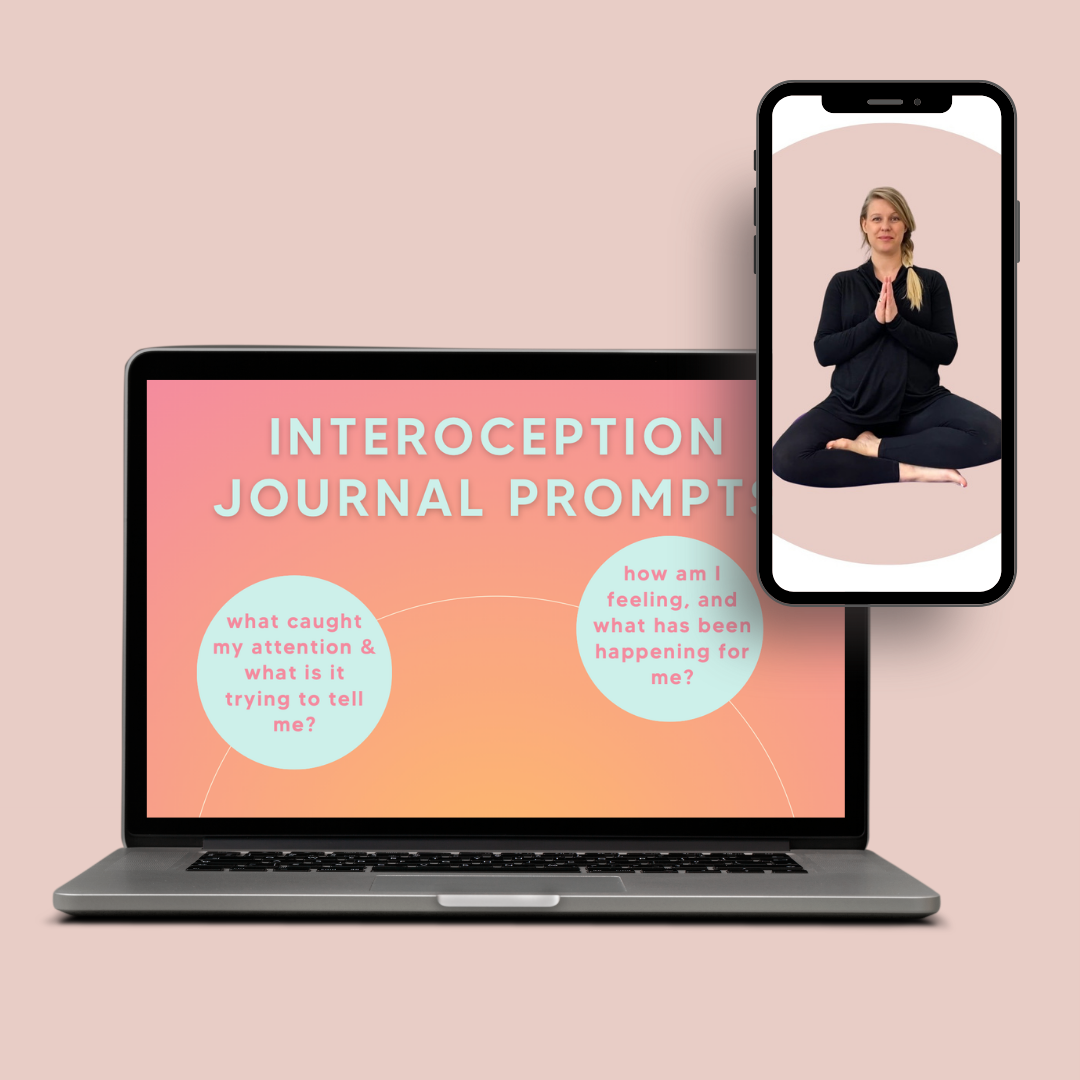
Interoception is our sense of what’s happening inside our body. It helps us notice signals such as hunger. Those signals can also contribute to our experience of emotions.
Your body offer you clues and signals and sensations, but it won’t tell you exactly why you feel that way.
Distraction (including doom-scrolling!), can sometimes offer short-term relief, and there’s no need to judge yourself for doing it. But when it takes you away from what matters to you, noticing earlier, might just open up another choice. That’s the invitation in these gorgeous journal prompts - to notice, pause, respond…
listen to
understanding interoception and yoga
where you get your podcasts
what is interoception?
Interoception includes both conscious and non-conscious sensing of the internal state of the body. Interoception connects an individual to virtually every functioning part of the physiological body.
Misrepresentations of internal states - or a disconnect between the states, and the interpretation of these states can affect our physical and mental wellbeing.
what does interoception have to do with yoga?
In a yoga class, you may well move into a forward fold and notice sensation in your hamstrings, which then probably leads you to become aware that there’s a lot going on there... and maybe that you're holding your breath. From there, maybe you notice your jaw is tense, you're getting tired, that your heart is beating more quickly, etc.
All of that involves interoception - noticing signals coming from inside your body.
But yoga gives us an opportunity to practise something else too: what we do with those signals:
notice - interpret - respond.
And this is so useful well beyond the yoga mat.
Off the yoga mat, your interoceptive sense might inform you your shoulders are flipping tense during a stressful afternoon, or you’re hungry, or you're getting overwhelmed. Noticing those whisper signals can give you an opportunity to respond to what you need before they become SHOUTS!
Interoception isn't constantly monitoring your body or correctly interpreting every sensation. A racing heart could be that you're anxious, excited, exercising, hot or that you've had a strong coffee. The aim is not to become a perfect body detective, but becoming a more and more and more familiar with the language of your own body.
And - guess what - this is something yoga gives us so many opportunities to practise.
FREE MEDITATION
Body scan for noticing sensation - an interoceptive practice

This gentle body scan is an invitation to notice what you can feel, without needing to explain it, change it or decide whether it is good or bad.
You'll be guided slowly through the body, exploring sensations such as warmth, heaviness, tingling, tightness, softness, pulsing, spaciousness and stillness. The practice encourages you to stay with direct physical sensation, rather than getting pulled into the stories, worries or judgements that can so easily accompany what we feel in the body.
Over time, this kind of practice can help train your attention to stay in the present moment and become more comfortable simply noticing what is here.
Enjoy!
transcript - Understanding interoception and yoga
Interoception is a term that came up in last week's episode about understanding what slow breathing actually does to brain and body Interoception is your nervous system sensing. Interoception is your nervous [00:01:00] system sensing, interpreting and responding to signals coming from inside your body. For example, this can be as simple as knowing that you're hungry, that that sensation in your tummy is your digestive system communicating that it's time for some more food. So what? Like why, why is this a thing? Why is it relevant? Well, if you have the ability, the available time, and the mental bandwidth to pay attention to these signals and to understand what they mean, then you can do something about them.
Maybe you notice, hmm, my shoulders are tired and they feel kinda tense and tight. Hmm. This might then lead you to realize you've actually been pretty tense about this impending deadline, and so then you can take action. Maybe you go for a calming walk or even just do some mindful shoulder rolls at your [00:02:00] desk.
This allows you to do something about improving the situation before it becomes any worse. So what has that got to do with yoga? Well, the physical practice of yoga is essentially mindful movement. Moving your body and being very present about that, breathing into here, finding more space here, put a hand here and a leg here, but don't go too far. And over time, I have really, really noticed this in my own teaching.
Over time, this means that a yogi can go from, "Ah, this is a huge amount of something doing in my hamstrings. What is going on here? Are they gonna actually just ping off my legs?" To, "Wow, my hamstrings really needed this stretch today. Wow, that feels lovely. This is a strong sensation, and I really feel [00:03:00] like it's creating more space and oh, okay, nope, that's, that's enough. That's far enough." And knowing when to stop going any further.
Importantly, this is deciphering the sensation. This is a sensation that's helpful to my body and going to offer benefits, or this, this sensation is a bad sensation. It's communicating something is risky. And like I mentioned last week, there's some really fascinating new research specifically looking at the interoception of the breath.
Last year, 2025, there was a study where 65 people completed a task, where small amounts of resistance were added to their inhalation. Researchers were looking at how accurately the participants could detect the resistance, their confidence in their judgment, and their resting brain connectivity.
So [00:04:00] we're not just gonna take from this that paying attention to your breath improves interoception. That's not what they tested. But it is a really, well, I think it's a really fascinating piece of evidence that the way that we perceive our breathing is part of this interoception, this brain-body communication
so if interoception's something that you'd like to work on at the moment, I've linked to my practice on Insight Timer, Nervous System Regulation: A Practice of Listening, and it takes you through this process, noticing some of the signals of settling, without necessarily just deciding that one is good and one is bad.
And without trying to kind of emulate a particular state, it's just about listening. And I have a really, really fab sheet for you as well, all about how interoception is the gateway to [00:05:00] helpful behaviors. Working on the basis that either we can be in touch with how we are, we can notice the whispers of something and do something about it, or we don't notice how we are, those whispers become shouts, shouts of anxiety or pain or frustration, and at that point, we're so dysregulated that we might accidentally undertake an unhelpful behavior, like buying something that we don't need or texting someone an angry message but our discomfort has nothing to do with them, et cetera.
You can find this sheet, Interoception: The Gateway to Helpful Behaviors, in the show notes. Look, this isn't ever something to beat yourself up about. Accidentally going back to unhelpful behaviors is a pest, but it's also a learning opportunity. What happened in the run-up? What signals were there? Was there [00:06:00] a knot in your tummy?
Were your shoulders tense? Did you start to feel your heart beating out of your chest? And if so, next time you notice that, is there something that you can do at the point of noticing a whisper before it comes a shout? And if you're looking at deepening your interoceptive skill, that would be a nudge to start or restart or deepen your yoga practice, building up your interoception skills so that they are there when you need them.
I really hope that you found that useful. Interoception is a life skill. It really is. So grab your worksheet, bookmark the listening practice, and treat yourself to some yummy yoga. What an absolutely yummy plan of action. thank you so, [00:07:00] so much for listening, and I'll see you next week. As always, happy practicing.