
Anxiety, overwhelm and burnout (and yoga)
Essentially we're looking at the consistent and regular activation of the fight or flight response...
So what can you do?! Anything you wouldn't do if a tiger was roaming around. Squats. Close your eyes. Focus on your exhale. Lie down. Shake....
Whatever you do, make it something you love, then it's more likely to stick if things get harder.
This episode walks you through what stress actually is, why stress leads to more stress, the relaxation response and then the evidence-base of how yoga helps.
Listen next
Understanding interoception and yoga — our introductory episode exploring what interoception is and why it matters, listen here
all of yoga podcast - episode 69
FREE MEDITATION
Body scan for noticing sensation - an interoceptive practice

This gentle body scan is an invitation to notice what you can feel, without needing to explain it, change it or decide whether it is good or bad.
You'll be guided slowly through the body, exploring sensations such as warmth, heaviness, tingling, tightness, softness, pulsing, spaciousness and stillness. The practice encourages you to stay with direct physical sensation, rather than getting pulled into the stories, worries or judgements that can so easily accompany what we feel in the body.
Over time, this kind of practice can help train your attention to stay in the present moment and become more comfortable simply noticing what is here.
You can practise lying down, sitting, standing or even gently moving, as long as you feel safe and comfortable.
There is nothing to achieve and no particular sensation you are supposed to find. Simply notice what you notice today.
listen to
anxiety, overwhelm and burnout (and yoga)
where you get your podcasts
FREE JOURNAL PROMPTS
your free interception journal prompts
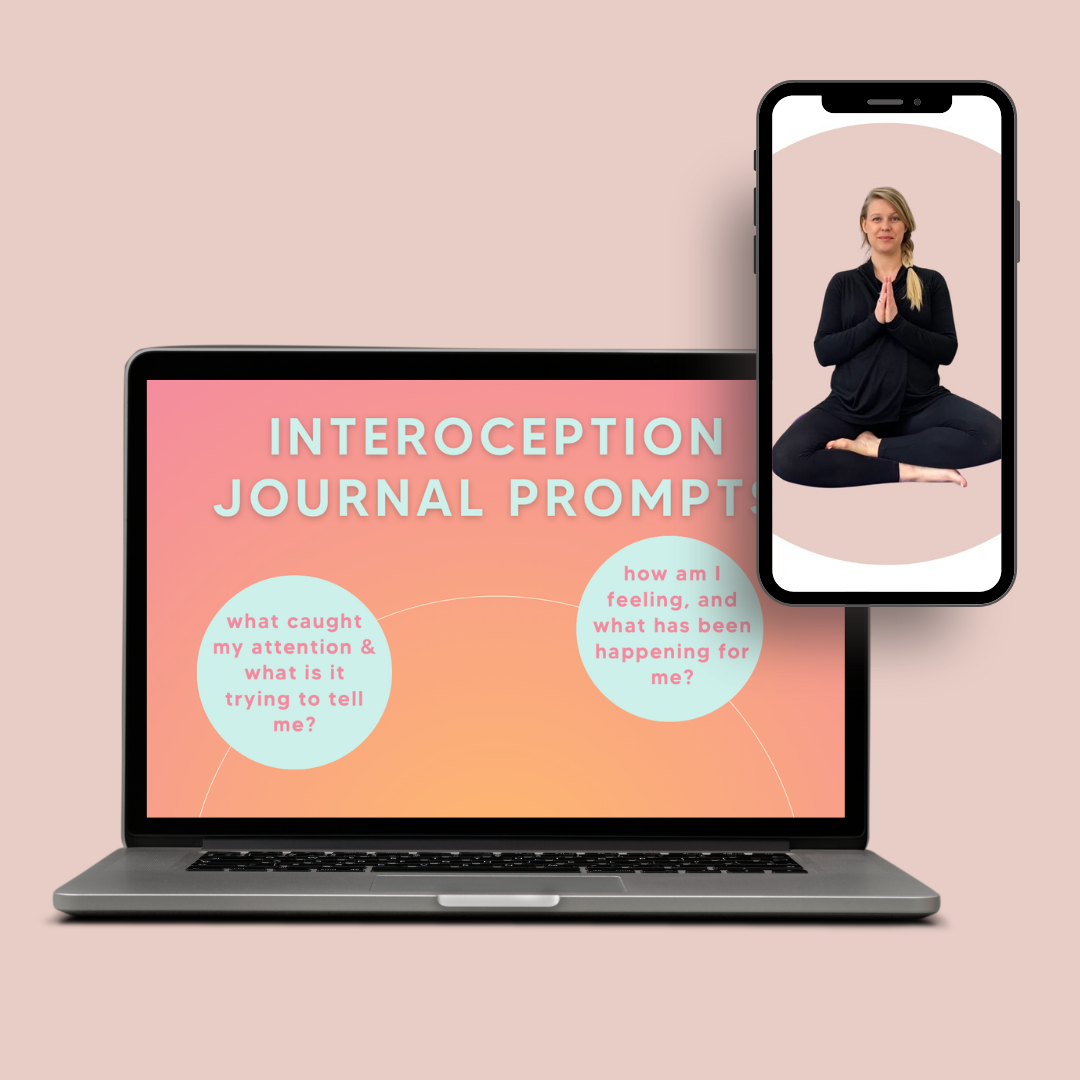
Interoception is our sense of what’s happening inside our body. It helps us notice signals such as hunger. Those signals can also contribute to our experience of emotions.
Your body offer you clues and signals and sensations, but it won’t tell you exactly why you feel that way.
Distraction (including doom-scrolling!), can sometimes offer short-term relief, and there’s no need to judge yourself for doing it. But when it takes you away from what matters to you, noticing earlier, might just open up another choice. That’s the invitation in these gorgeous journal prompts - to notice, pause, respond…
Transcript - Anxiety, overwhelm and burnout (and yoga)
[00:00:00] feel like currently I'm talking about the impact of stress about 95% of the time, and the remaining 5% is guiding movements and breathing techniques and meditation [00:01:00] practices and so on. Like, it's that strong of a split. Oh my goodness, stress, anxiety, overwhelm, burnout, they seem to be absolutely rife. How do you feel?
Do you feel like you're experiencing more stress than normal? Well, yeah. Most of my current clients are coming for some sort of anxiety, stress, overwhelm, burnout. These, of course, these terms have, um, differences and nuances, but that said, I think an understanding of what's going on in the body and the brain when we are under pressure can be incredibly helpful, even if it leads to some self-compassion in a challenging time So with that in mind, in this [00:02:00] episode, we're first going to look at what stress is and what will affect, impact your unique response to a stress trigger. I'll then break down the two different stress responses.
Sneak peek. Firstly, we have the nervous system response, and then we have the hormonal response. And then I'll go back a step or two to look at how stress often creates more stress. Overwhelm often creates more overwhelm. Anxiety causes more anxiety, and so on. This has the potential to be very depressing, and sometimes it can actually make us get stressed about being stressed.
So then I will tell you about research that shows us how yoga can [00:03:00] help activate the opposite to the stress response, the relaxation response, and how the compounding effects of stress can slowly but surely be undone with new habits, new practices, new tools, and new ways of looking at life. But let me tell you right now, if you feel anxious, constantly distracted, tense, You feel like there's not enough hours in the day, your jaw aches when you wake up in the morning, anything like that, I know you're not alone.
I know that it's super common for to think, "Well, I don't necessarily have more to do or more to worry about than the next person, so why should I do anything about my stress?" But just because it's common does mean that it's right or [00:04:00] that it should be expected, or that you should just get on with it because everyone else is.
Listen to the research at the end of the episode. Do the regulating practices that you love, or come and do some therapeutic yoga with me, or get your weekly lunchtime reset online with me every Friday. Do what you love, and it's more likely to stick when things get more challenging, which is really important.
Okay, let's get cracking An introduction to stress
So here I'm kind of maybe quite clumsily using stress as an umbrella term for anxiety, overwhelm, burnout, being under pressure, et cetera. And refers to any stimulus that provokes or requires a response [00:05:00] from the body. The charity Mind defines stress as, "Stress is how we react when we feel under pressure or threatened.
It usually happens when we're in a situation that we don't feel we can manage or control." in society, stress generally has a negative connotation, but some levels of stress are present in many activities that give us meaning as a human. Okay. So your unique individual response to stress is shaped by your current stress load, your individual genetic expression for stress, which can change over time, your previous experiences with stress, and your stress management toolbox. Let's just look at the first one for a moment, your current stress [00:06:00] load.
Let's say that you and I both go to our cars this morning, try and start them up, and realise that the battery is flat. You were gonna use your car to drive to a spa day or a massage or something else that you might really love to do, which you can reschedule no problem and with no financial impact.
I was going to use my car to drive to work to earn some money because I have none left let's say You have just been on holiday for a couple of weeks. You feel very, very, very calm. You've actually got a couple of days off just to decompress a little bit more before you go back.
You are so confident that your colleagues have kept your workload going, and you're kind of looking forward to getting back. You certainly don't feel like it's gonna be a big stressful return. [00:07:00] Whereas I am spinning 8,000 plates and got lots on my mind and so on. Okay. So basically what I'm trying to do is provide a story where your current stress load and my current stress load are very, very different.
And so even though we've experienced the same situation, a flat battery and a car that won't start, it's actually impacted us much more differently. For me, I might just burst into tears, and for you, you might calmly ring, um, someone who's got some jump leads or whatever, right? So the way that we can sort of take that and think about it in a way that's actually useful in your everyday life is that it's super important to take steps to manage your current stress load.
And by that I don't necessarily mean getting rid [00:08:00] of external things like projects and deadlines and whatever, although that might be super useful. I'm actually meaning reducing your stress load by purposefully activating the relaxation response every day. And of course, I'll get to that in a minute
Let's also just briefly talk about the third of those four things, previous experiences with stress. If you have been challenged very regularly, but you've been able to rise to those challenges and they've benefited your life in really great ways, that will change how you approach a stress trigger compared to if life had been incredibly stressful and the stress triggers were really negative in your life and caused really, really negative things.
All right. And then lastly, an individual's response to stress is shaped by their stress management toolbox [00:09:00] If you want to build your stress management toolbox, maybe book in a free 15-minute chat with me because everybody's toolbox is different. Now, there might be some movement in there, some breathing techniques, some techniques for focusing the mind, but building a toolbox that's perfect for you is really important All right, let's move on because I want to talk about the stress response mechanisms. when humans are exposed to a stressor, there are two responses, the sympathetic nervous system and the HPA axis. So when a human encounters a stressor, the initial response is neural.
The autonomic nervous system activates the sympathetic nervous system, basically the fight or flight response. [00:10:00] And then soon after, the HPA axis is activated to release cortisol, one of our stress hormones. This is slower to activate than the neural response, and it lasts longer. So bearing in mind that the human stress responses evolved to support survival, let's have a look at them both in more detail.
The sympathetic nervous system is part of the autonomic nervous system, and its function is to excite, to activate, to up-regulate the nervous system, maybe mildly to engage us in an activity, or maybe more acutely to help us respond to something that might be a threat to our survival. And you might already know this as the fight or flight response, and we can think about it like this If you were to imagine that a saber-toothed tiger was to walk into the room that you're in at the moment, what would you want to [00:11:00] happen to give you the highest possible chance of survival?
You'd want access to all of your energy to fight or to run away from the tiger. You'd want your brain to focus on getting you out of that situation and not, for example, focus on that email reply that you need to send to Fred or what you need to buy for your tea tonight. You'd want your immune system to step up in order to fight a potential infection in a cut caused by fighting the tiger.
And the good news is, this is exactly what happens. Your blood is directed to your skeletal muscles and your brain to help deliver oxygen and glucose so that the muscles and the brain have access to as much energy as possible. This means blood is directed away from the digestive organs and the skin because in this survival state, there is absolutely no point wasting valuable energy on digesting [00:12:00] food which might not be needed, and to avoid bleeding out respectively.
Your heart rate, your blood pressure, and your breath rate all increase to move the blood around the body really quickly in order to deliver that oxygen and glucose. The inflammatory response is activated to fight off infection, and this is a survival mechanism, and it functions well when, this is really important, the stressor has an endpoint However, in the modern world we live in now, stressors don't usually have a clear endpoint.
Stressors are less likely to be a saber-toothed tiger and may be more likely to be a credit card debt, a disagreement with a family member, an increasing workload, and so on. And the key takeaway here is that because these situations don't necessarily have an endpoint, [00:13:00] the sympathetic nervous system continues to fire, which ultimately uses up your vital bodily resources, potentially damaging tissues. And also, I told you it was depressing, didn't I? Not only do our modern stressful situations not have a clear endpoint, but they also don't require the fight or flight response. They usually require a cool head, an ability to think things through. Let's return to an example I mentioned earlier of credit card debt.
If punching your credit card bill was the solution, then the fight or flight response would be perfect. However, it's not a solution. Kicking the bill or running away from the debt will cause more problems and therefore more stress, and so you could say this is a vicious cycle. Unfortunately, and I think that this is really, really important if we're thinking about stress through the [00:14:00] lens of self-compassion, keeping a cool head is not something that is there by design when stressors appear.
think about it. If a saber-tooth tiger jumped out at you, your autonomic nervous system should and will respond immediately. There is no point wasting even milliseconds wondering, "Hmm, I wonder if this tiger's hungry today. Maybe he's already had breakfast."
That time is vital. Your body knows that, and so it responds without thinking things through. This is what happens when you open your credit card bill and you see it's bigger than you were expecting. The sympathetic nervous system reacts immediately, and this adds on to our vicious cycle
And there's one more thing to say before we get onto the HPA axis, and then we start looking at the more reassuring things. You may have heard the phrase, [00:15:00] "Neurons that fire together, wire together." Put simply, the more the sympathetic nervous system fires without conscious intervention from you, the more it will fire.
So it works like this. Something happens, the neural stress response fires. This might activate the part of the brain involved in reacting rather than pausing and planning and choosing what you would like to say or do. This uses up a ton of energy, and it further solidifies that response as an option for your brain in the future.
Okay. So now let's look at the second stress response, the HPA axis. Like I said before, this is slower to respond than the neural response, and ultimately it results in cortisol being released into the bloodstream. Cortisol can and [00:16:00] will have a huge and ongoing impact on the body when released in large and ongoing amounts, such as cortisol is antagonistic to insulin.
Antagonistic means they work against each other. So cortisol being released into the bloodstream will have an impact on glucose production, potentially meaning that cells can become resistant to insulin. Cortisol negatively affects hunger and satiety cues, so please putting to one side what society says about how we should look or what we should or shouldn't weigh.
Let's just put that to one side
Not getting signals of hunger or not getting signals of satiety when eating obviously have a big impact on the enjoyment of food, the function of the digestive system, and so on. Cortisol is antagonistic to melatonin. I go into this in some depth [00:17:00] in our Six Weeks to Deeper Sleep course. Melatonin is an important hormone in establishing sleep cycles.
And then finally, for now, cortisol prevents the release of cells that cause inflammation, which means that with ongoing cortisol release, people might become more susceptible to infection and/or take longer to recover
Okay, so we've arrived. We are now gonna talk about the relaxation response. So the relaxation response from a neural point of view is the activation of the parasympathetic nervous system. This is where your heart rate, breath rate, and blood pressure return to your normal.
The skeletal muscles start to untense, if that's a word because they're no longer needing to be prepared for [00:18:00] fight or flight at a moment's notice. Blood is rerouted, redirected as needed throughout the body, so the digestive system receives blood and so does the skin. And then in terms of the hormonal aspect, The relaxation response results in cortisol no longer being released into the bloodstream. So all of those things that I mentioned earlier can return back to your normal. The production of insulin, hunger and satiety cues can present themselves, melatonin can be released, and that's really important for establishing our wake-sleep cycles.
Inflammation can return back to your normal, and so on
How yoga mitigates the stress responses. Do you remember at the beginning of this episode we talked about how stress is affected [00:19:00] by four things? Current stress load, individual expression for stress, previous experiences with stress, and stress management toolbox Well, research has shown that practising yoga can enhance rational thinking, focus, emotional regulation, and decision-making. So while those two stress responses will most likely happen as a result of a stress trigger, we're kind of not a victim to that. The rational parts of the mind can start to then fire up quite quickly in those of us that practice yoga Yoga also decreases fear, hypervigilance, and emotional re-reactivity.
So when we talked about stress leading to more stress, potentially practising yoga can interrupt this cycle Yoga also improves attentional control and cognitive flexibility, [00:20:00] meaning that it starts to give us a little bit of agency, a little bit of empowerment, a bit of confidence to choose how we see situations.
Is the flat battery in my car a day-ruining stressful situation, or can I take a beat and think it through a little bit more? Yoga also reduces circulating cortisol, which then reduces the impact of all of those cortisol things that I mentioned earlier on. And yoga increases GABA. GABA is a neurotransmitter which supports calm and focus and mental balance, and when there's increased GABA, that's linked with reduced anxiety and depression. And finally, research has shown that yoga improves functional connectivity between brain regions. So there's brain regions that fire up in the face of stress that are linked with [00:21:00] the fear response and fear detection and emotional reactivity, and they will probably light up in the face of stress.
But if we can then link that region with the more rational regions, it means that we can switch on rational thinking much more easily in the future So go and do more yoga.
I mentioned at the beginning, the really, really important thing is to do the practices that you love. If you love moving quickly and getting a sweat on, then go for it. If you love lying down and being guided, do that. I'll link to some guided meditations on Insight Timer right here in the show notes.
If you wanna move slowly and mindfully and really connect with what's going on in your body, or you want to journal, or you want simple repeated movements, or you want to talk it out, or you want to focus your mind on a mantra, or you want to [00:22:00] use your breath, that's great. Do what you love. Try to create a toolbox of practices and use what feels right in that moment.
But if you take only one thing away from this whole episode, let it be that unfortunately, stress and the impacts of stress do not disappear on their own. We have to do the work. We have, have, have to do the work. And so let that be the practices that you love. So go forth and do something for your relaxation response, and as always, happy practicing