
the other 7 limbs of yoga
all of yoga podcast · episode 35
When most people think of yoga, they picture the physical postures; the asana. But there’s so much more to yoga…
In this week’s All of Yoga podcast, we're exploring the Eight Limbs of Yoga - but with a twist! You're probably already familiar asana (limb 3), so this episode is The Other 7 Limbs.
Expect to hear how the yamas, niyamas, breathwork, and meditation can become practical tools for daily life — helping you reduce stress, and feel more joy… without spiritual bypassing.
I also share a personal story from 2020, when yoga philosophy helped me navigate one of the most challenging years of my life.
Whether you’re new to yoga philosophy or have studied it before, this episode is packed with insights you can start using right now.
FREE WORKSHOP
yoga: beyond the asana
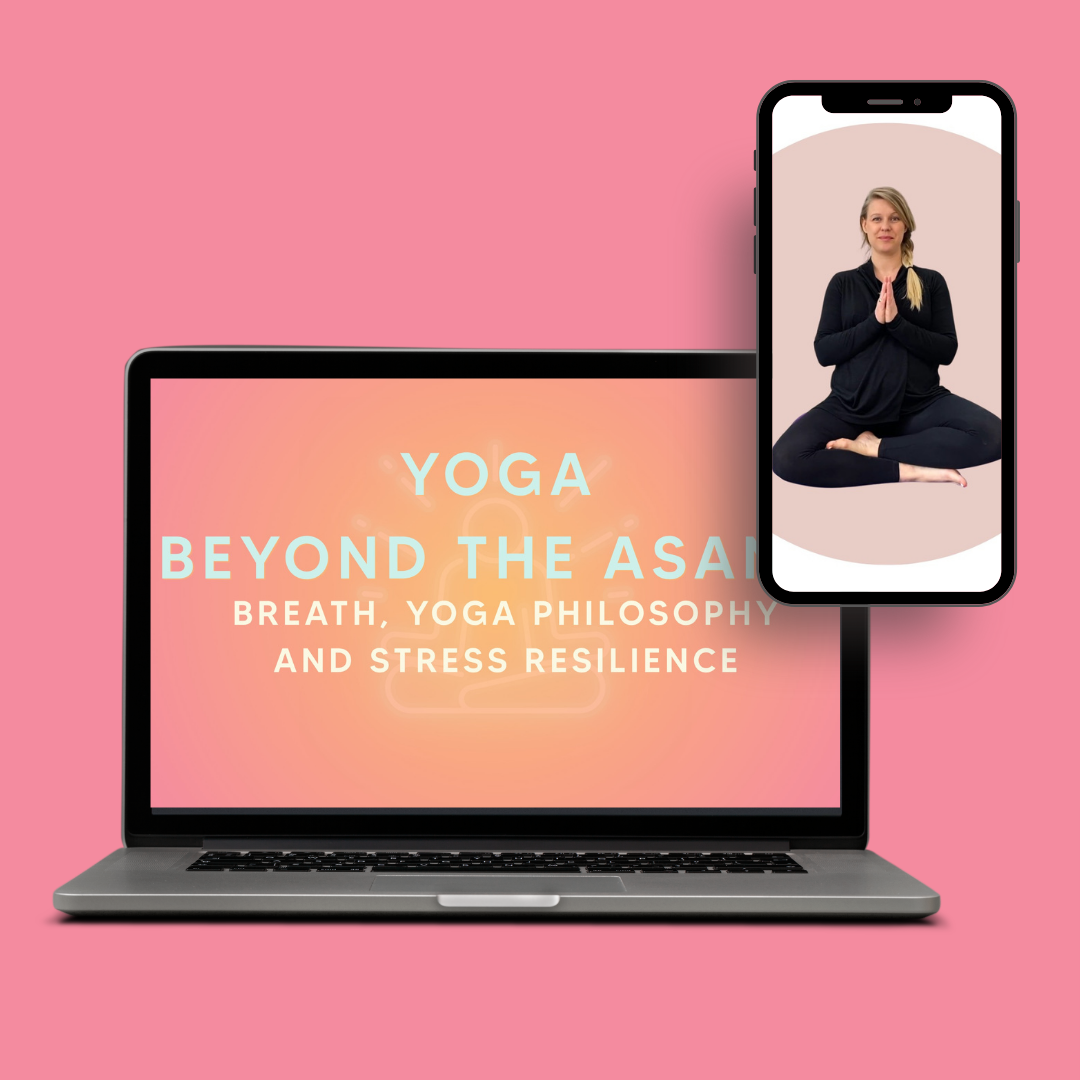
In this free online workshop, we explore yoga beyond the asana - from understanding the body’s response to stress to applying ancient yoga philosophy in everyday life. Plus:
how movement, breathing and attention can support a return to balance
the eight limbs of yoga, including the Yamas and Niyamas
how yoga can become something we live (not just something we do on a mat )
AND you’ll get short, guided practices and an invitation to take one aspect of yoga into your life straight away. Save your seat 👇
listen to
the other 7 limbs
where you get your podcasts
transcript - the other 7 limbs
So, this is where we’re going. I’ll take you through each of the 8 limbs, one by one, and look at what they mean for our yoga practice, and also, what they mean for our daily living. Because yoga is not headstands and quick, take a picture! It’s about the stilling of the mind. It’s about not being pulled and dragged around by the judgements on pre-conceptions that you have about life, about yourself and about other people. It’s about uncovering joy, which can be experienced alongside sadness, jealousy, anger. It’s about decreasing pain and discomfort, not by ignoring them but by like i said before, facing them head on and just doing your best.
So, yes, I’ll take you through each of the 8 limbs, one by one. I would say, mark this podcast and come back to it as often as you need to. Just take, today, what you need for today. What’s relevant to your life as it is at the moment, taking into account your energy levels, your intention, the challenges you have at the moment and your free time. Resolve to work on just one thing at once, and come back to this episode when you need it or when you’re ready to take on busting an old unhelpful habit, or creating a new, helpful habit, or you’ve got a challenging situation at work, or whatever it is..
Ok, so for real this time, let’s get cracking!
1. The yamas
The yamas are the first limb of the 8 limbs of yoga, and they mean ethical observances. Essentially. Ways that you act in the world; ways that you treat other people and how you treat yourself. And there’s 5 of them, let’s take a look:
Ahimsa - non-harm
So if you’re a regular yoga practitioner, you may have already heard of ahmisa from one of your yoga teachers. It means non-harm, non-hurting. And we can think about it as compassion; for yourself and for others. And I think - honestly - after 12 years of teaching yoga. We could actually end the philosophy lesson here, we really could. Because, if you were to put non-harm at the front and centre of all of your thoughts, all of your spoken words and all of your actions, you’d be so mindful of everything you said and did, you’d really be in the present moment, and everything you said and did would be so in line with your values that you’d be experiencing non-stop joy and very little discomfort and pain.
But.
This isn’t very realistic is it, you’d barely get anything done, I’m not sure your employer would be overly happy that everything was taking you 20 times longer etc. However, what about an hour a day, to put non-harm - for yourself and others - at the forefront of your thoughts, words and actions?
And hero, there’s another really important things that I absolutely MUST explain here, which is that being a yogi, and practising yoga philosophy: does not make you a doormat. If your boss says here’s yet another project to add to your exploding workload, or your friend says you must cancel your plans and give me a lift to my date even though you already said you couldn't and you're pretty tired, you’re not going to give in, you’re not a doormat. Ahimsa is non-harm to you, too. So how do you decide what to do? Well, think about Ahimsa in terms of the least amount of harm, to the most amount of people, for the longest period of time. So you consider each case on a case-by-case basis. WIth the extra project, if it’s a quick one, you’re the best person for the job and it’ll mean one late night, you might take it on and ask for time off in lieu, for example. But if it’s a huge project, you know your boss is coming to you because you’re most likely to give in and say yes, then the ramifications of it are huge - lots of late nights, lots more stress and we’ve talked so much recently on the podcast about just how dangerous chronic stress is, and your boss will only keep coming to you when they have no one else - so here, the non-harm action might be to say no, I won’t do the best job, I’m concerned about my health and so the answer is no, and perhaps you need to think about hiring.
So - how do you decide what is the most non-harm path? Well, there’s a couple ways. One is to take a beat and have a think about what you think the consequences will be - there’s no way you can properly predict, but you can try, you can do your best - and actually that’s something that will come up a lot, to do your best. Anyway, yeah, you can just try to predict what will cause the least amount of harm to the most amount of people for the longest period of time, and do that.
Another tool is to assess the different options in line with your values and intentions at that moment. So if your intentions currently are to do everything you can to get a pay rise and a promotion, you might take on the project. But if your intentions currently are about tackling work / life balance, and spending more time with friends and family, it’d be a no.
Ok, so ahimsa, such an incredible place to start thinking about yoga philosophy - about increasing life’s joy and decreasing life’s discomfort. Truly.
If you’re the kind of person that loves an action plan, I’d say, for an hour later today, put non-harm at the forefront of your thoughts - yes really! When you notice your thoughts, interrupt them and make them ahmisa, make them non-harmful to yourself and to others. Put ahmisa at the forefront of your spoken words and your actions. Just do your best. It’s not easy, not at all, but it’s possible. Then do an hour tomorrow, and the next day… and just see what happens.
Satya - truthfulness
Ok so this blew my little mind - how can the first yama be non-harm and the second, truthfulness? Aren’t they contradictory?! Do you feel the same? Well, let’s take a look. Is that because, actually - like me - you’re thinking that ahmisa is doormatty? That acting with ahimsa is putting yourself last, but truthfulness is putting yourself first, and that’s why they’re contradictory?
And so, if we actually go back to that view of ahmisa as being the least amount of harm for the most amount of people for the longest period of time, and that you try to act in the best view by acting in accordance with your values, then it makes sense. A lot of sense. Because your values are - without sounding tooooo cheesey, your values are your truth, right? And so when you’re thinking, speaking and acting, are they in ways that are true to yourself?
There’s another thing here too - let’s go back to thinking about yoga, not just as the asana but as the stilling of the mind. And there’s two ways we can do this, one is to deal with all the stuff that’s already in your mind - good luck! And the second way, that we can work on at the same time as the first, is to stop putting a whole new load of stuff into our minds. And lying, not being truthful is most certainly dumping a whole load of new stuff into your mind for your future self to deal with.
Let’s say your friend asks you out to dinner, but you’ve been on your yoga teacher training course all day and you’re tired. But you don't want to say that, she might be offended. So you say your car broke down. So now you have to remember, your car broke down. And next time you see her, she asks what was wrong with your car, and did you have to get a breakdown van? And how did you get home? Or were you already at home? And which garage did the repairs because her car needs a service soon and she wants a recommendation.
So satya, truthfulness is trying to make sure that we don’t get into this web of lies, because every lie creates a web doesn’t it - and that’s not very in line with a life headed towards a stiller mind.
Asteya - non-stealing
I mean, yeah, not a surprise, is it? If it’s not yours, don’t take it.
Brahmacharya - moderation of energy
Ok so this is a really interesting one, because it’s often translated as celibacy or chastity. I think about it as moderation of energy; thinking about where you are putting your valuable, finite resources of mental bandwidth, energy and time. So often I’ll talk to people who say they’d love to do more yoga but they don’t have time. And if I then run through their day with them, they realise, they’re actually spending tons of time extra at their desk, or doom scrolling, or whatever. No, there’s no judgement here, not at all. None.
But.
If you, or someone else, has expressed a desire to do something that would improve their life immeasurably in every way, it can be an interesting exercise to run through: Ok what are you spending your precious resources of energy, mental bandwidth and time on. And what do you want to spend them on. And how can you align the two?
And I know I keep talking about your values, your values, your values. You might already know these, and if so that’s so so great. But if you don’t, it you haven’t defined them or they need a refresh, come and join our free online workshop:
Living in Alignment: A yoga philosophy journey to define your true values
I’ll talk a bit more about this later, but for now, you can find the link to save your space in the shownotes.
Aparigraha - non-hoarding
Once again hero, there is absolutely no judgement. Not at all. I mean you should see the show cupboard in our house! So yeah, no judgement whatsoever. This is a pretty cool yama. THink about it like this. I have an orange bucket. I know where my orange bucket is, I know that it doesn’t have any holes in and that the handle works. I know it's clean. Great.
Now imagine I have an orange bucket and a purple bucket. Where is my orange bucket? Where is my purple bucket? Is my orange bucket clean? Is my purple bucket clean? Does the handle on my orange bucket work properly? Does the handle on my purple bucket work properly? Aaaaand so on. So you can see that having more things, owning more things just simply contributes to more thoughts. And if we go back to yoga as being a practice to help still the mind, aparigraha; non hoarding, fits with this as less belongings = less thoughts for your future self. But like I say, absolutely no judgement!
And so that’s the yamas complete, heroes, aren’t they cool? Let’s go over them again -
Non-harm
Truthfulness
Non-stealing
Moderation of energy
Non-hoarding.
2. Niyamas
If you think about the first limb, the yamas being how you treat everyone and how you act in the world, the niyamas are very much about how you treat yourself.
And again, we have five.
Saucha - cleanliness or purity
Think about having a clean house for your soul. This always makes me think of the rom com films where the couple have split up and they both haven’t showered for days, the washing up is piled high up out of the sink etc. Then, they move on or get back together or whatever, and this is symbolised by the characters who are freshly clean, their apartments are clean etc etc. This has big links with self care and to a point, self-esteem. Someone’s cleanliness of themselves and their environment can drop with their self esteem. Of course, it’s possible for people to clean obsessively too, and for the avoidance of doubt, that’s not what this niyama is asking.
Santosha - contentment, gratitude, cheerfulness
I love this niyama. Having taught yoga for so long, and yoga really being about kind self-improvement, generally i see people being so chuffing hard on themselves, trying to get a promotion, keeping a ship shape house going, many caring for dependents, whilst also trying to look after their physical and mental health, learn a language, see friends and family, do well at work. It’s exhausting thinking about it isn’t it! Phew!
So if we introduce this niyama, santosha, contentment into even just aspects of our lives, it’s the driver behind finding content, joy, and gratitude for things as they are. This is really important; for things as they are. So let’s do that right now - think of one part of your life, might be a person or pet, a skill, an achievement that you’re grateful for. And when you find yourself striving, match it with a pause and finding gratitude. It’s a practice that’s FULL of potential, I promise!
Tapas - discipline
This tends to be one that people remember clearly hahah - but it’s not delicious Spanish food, it’s a Sanskrit word meaning discipline. And I think this is a healthy one to balance out with ahimasa, with non-harm. So when you’re aiming to get on your yoga mat, when you’re aiming to start a meditation practice, coming at it with a healthy dose of self-compassion AND discipline will hopefully mean that you do it whilst not beating yourself up about it.
Yoga isn’t necessarily this super kind, gentle, accepting of everything practice that everyone thinks it is. It’s sometimes pretty hard. Sometimes you just have to do the thing that’s hard, you have to have the hard conversation, you have to get up and out of bed and sit in meditation, you have to discipline with yourself to say no… whatever it is, i’m sure you know aspects in your life where you know you need to take action - and that is why tapas is here, hero. Interestingly, tapas also means heat and burning; it’s like your fire in your belly to get that thing done. You can do it!
Svadyaya - self-study
Svadyaya - self study asks us to reflect on our thoughts, words and actions. Why do we think that, why did we say that in the heat of the moment, why did I react that way. And this isn’t just so you can beat yourself up - it’s so you can learn from it.
Ishvara Pranidhana - surrender
Surrendering to a higher power, which might be a deity, it might be karma, it might be fate. But understanding that there’s plenty at play here, and that unfortunately the world doesn't revolve around you 0 although I’m sure you don’t think it does/
And they’re our niyamas:
Cleanliness
Contentment
Discipline
Self - study
Surrender.
Cool hey
3. Asana - physical practice
Ok so our third limb is asana. And this is why this episode is called the other 7 limbs, as I’m betting most of us are already familiar with this one. Asana is a sanskrit word actually meaning seat, rather than pose, interestingly enough, this is the main focus of yoga classes in the west. How, if you want to know how, to practice yoga perfectly, how to practice right, you’ll find our guide to perfect alignment in the shownotes.
4. Pranayama - breathwork
Prana is yoga’s mythical energy that courses through us. Next week on the podcast I’ll be introducing you to your five layers of being, one of which is this energetic layer, so now back to pranayama. So prana is the energy, and yama was our first limb which meant restrictions. So you might think that this is restricting your energy bUT! There’s a hidden extra ‘a’ in the word of prana yama which indicates a negative, so it’s actually non restriction of your energy! And if you’ve ever practiced pranayama, I think you’ll agree with that. On each morning of our yoga teacher training, we start with pranayama - with breathwork, and people start to notice how it really changes their energy and their view on things, quite incredible really.
5. Pratyahara - withdrawing attention away from the senses
Yoga talks a lot about the power of the senses and how they can drag us around. Let’s say you’re walking down the street feeling really content, then a song comes on that reminds you of your ex who you haven’t got over, and quick as a flash you’re really down in the dumps. But then, you hear your best friend’s infectious laugh and you’re happy again.
Imagine if - again not in a spiritual bypassing way but just in a way that you’re steady, imagine if you could experience and appreciate the highs and lows of emotion, always knowing you have a steady centre to come back to. And this is kind of pratyahara, withdrawing attention away from the senses. Not being dragged around by sights, smells and sounds.
6. Dharana - concentration
Ok so just a quick review to put concentration into context. We started with the yamas; ways that you act in the world. Then it narrows a bit with the niyamas, focusing on how you treat yourself, then we come in more still with asana, how you move your physical body around, then further still with pranayama focusing on the energy inside your body, and with pratyahara we’re withdrawing attention away from the outside world and coming much more inwards… to … limb number 6 - dharana - concentration.
And this practice just simply asks us to focus on one thing. I think the term meditation has got really tied up in people thinking they have to sit on the floor, they have to do it at 5am, they have to already have a clear mind. No no no no! Think of it like this; You’re just doing your best to concentrate on one thing. Your mind will wander, because you’re a human with a thinking mind, and when it does, you’ll bring it back to that one thing that you’re concentrating on. AGain and again. With ahimsa, with compassion, but also with tapas, with discipline!
And the practice of dharana leads to…
7. Dhyana - meditation
Here, meditation is a state of one pointed focus. Everything else has dropped away, and you’re in a zen state, full of joy, calm, peace. Yummy. And when this state is access repeatedly
It leads to …
8 Samadhi - ultimate contentment
There’s different layers of samadhi, but you can think of it as a state that comes and goes where you feel blissful, joyful, peaceful. You still experience the ups and downs of life, but have that steady centre to come back. Doesn’t that sound awesome? Yeah I think so too.
So there you have it, hero. Yoga is so much more than just the poses, although moving your body around is vitally important for physical and mental health. But, I think it's important to acknowledge and understand that yoga is so much more, and that it has so much more to give us, too.